



SEO STRATEGY
Building sustainable search visibility through structured optimisation
Search performance rarely depends on isolated adjustments.
Visibility is shaped by architecture, intent alignment, crawl accessibility, and topical authority — interacting as a system rather than independent variables.
ELKEON approaches optimisation through structured evaluation and iterative refinement.
The following sections outline recurring constraints observed across digital environments and the frameworks applied to address them.
Breaking Through Limited Organic Visibility
Across industries, several structural patterns repeatedly limit discovery:
- Fragmented page hierarchy and internal linking dilution
- Misalignment between content and search intent
- Technical inefficiencies affecting crawl or rendering
- Competitive saturation within high-value keyword segments
Understanding interaction between these elements defines strategic direction before optimisation begins.
Example scenario:
A service provider with dozens of landing pages targeting similar queries may see impressions distributed across competing URLs rather than consolidated visibility on priority pages.
Content Architecture Strategy
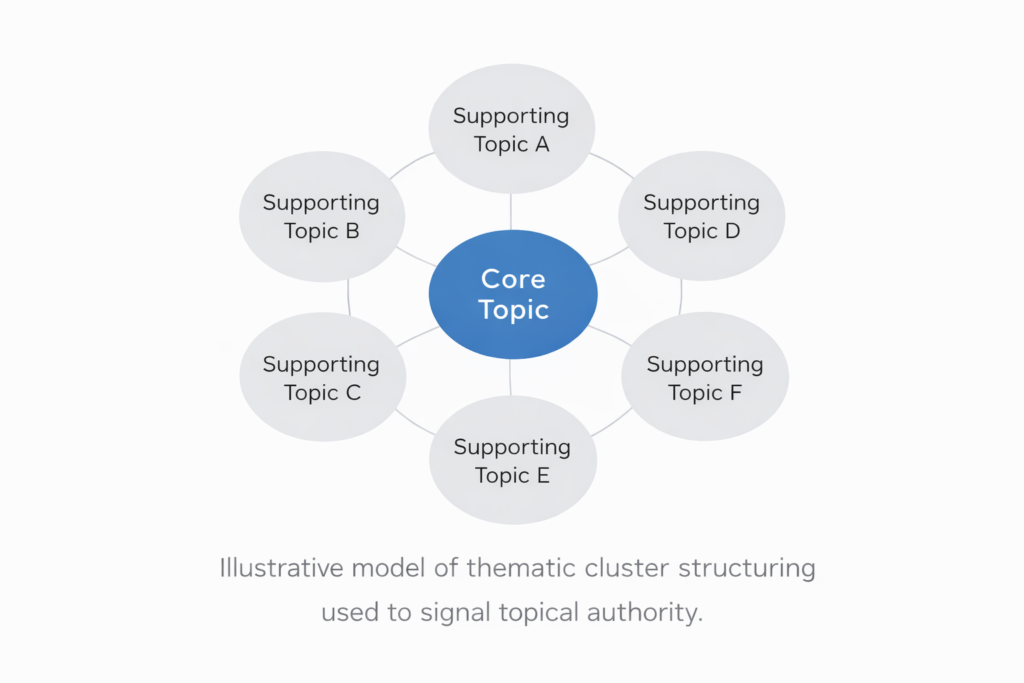
Cluster structuring expands semantic coverage by organising related content into interconnected nodes supporting a central topic.
Benefits include:
- Improved crawl interpretation
- Authority signalling through depth of coverage
- Enhanced navigation paths for users
- Reduced content redundancy
Rather than expanding volume indiscriminately, structured coverage prioritises coherence and relationship mapping.
Example scenario:
An organisation publishing blog content over several years without thematic structure may discover that high-value topics remain weakly connected, limiting authority development.
Intent Alignment Framework
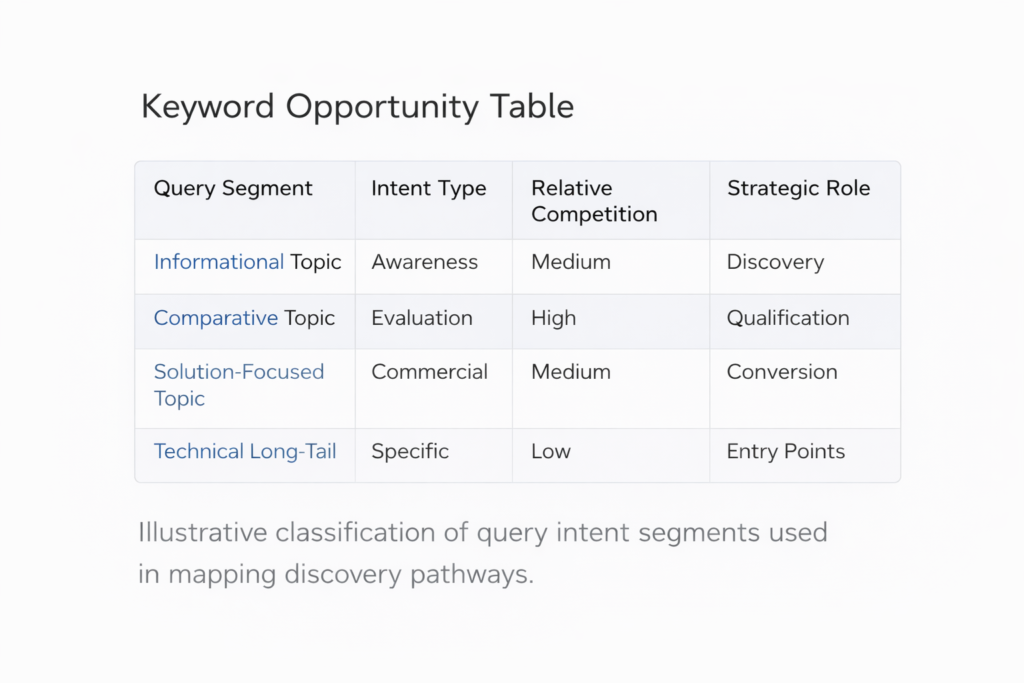
High-volume queries often produce visibility without engagement, while lower-volume targeted queries generate qualified interaction.
Strategic mapping therefore balances:
- Awareness acquisition
- Intent depth progression
- Conversion pathway continuity
This layered targeting model aligns content deployment with behavioural stages rather than traffic metrics alone.
Example scenario:
Traffic growth from broad informational queries may increase sessions while producing little enquiry activity when content does not match decision-stage intent.
Technical Evaluation Layer
Search accessibility depends on mechanical clarity:
- Rendering reliability
- Loading efficiency
- Indexation consistency
- Structured markup coherence
Optimisation focuses on interpretability for search systems, ensuring pages can be evaluated without ambiguity.
Example scenario:
Slow rendering or inconsistent indexing can result in key service pages being evaluated less frequently than lower-priority content.
Monitoring & Iteration
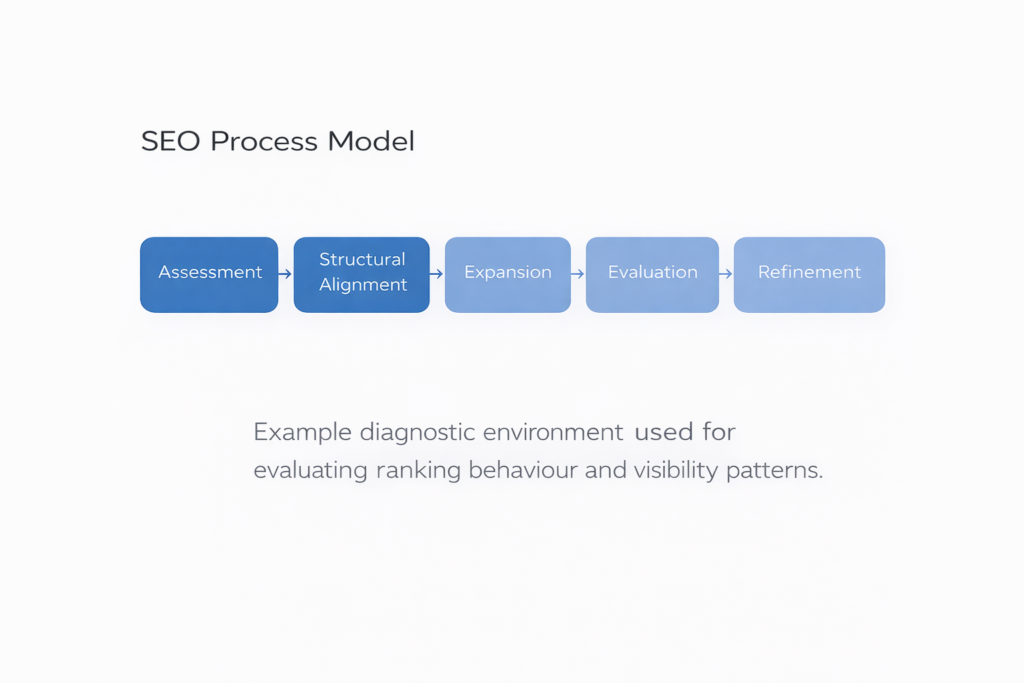
Search ecosystems evolve continuously through:
- Algorithmic adjustments
- Competitor movement
- Behavioural shifts
Sustained performance requires ongoing observation and calibration rather than static implementation.
Example scenario:
Ranking gains achieved after optimisation may fluctuate if competitor expansion or algorithm adjustments are not continuously evaluated.
Analytical Tool Environment
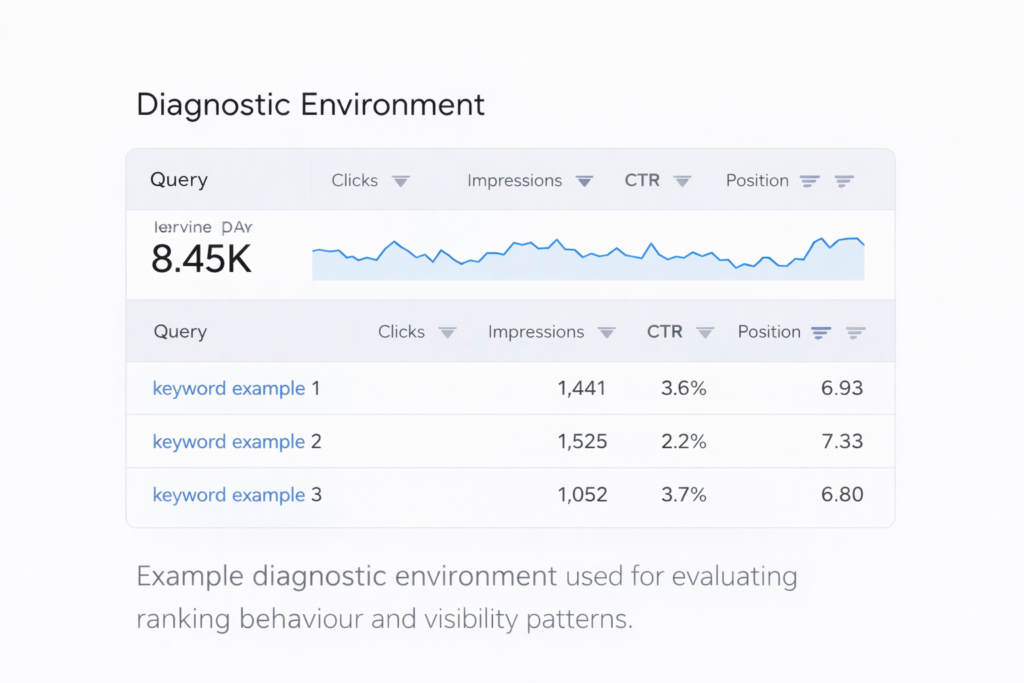
Strategic evaluation is supported by diagnostic platforms such as:
- Search Console
- Analytics environments
- Crawling diagnostics
- Performance measurement tools
- Mapping frameworks
Tools provide signals — interpretation defines direction.
Example scenario:
Diagnostic data may reveal crawl concentration on archive paths while strategic landing assets receive limited search attention.
Observed Industry Patterns
Repeated exposure to varied digital structures reveals recurring dynamics:
- Structural clarity often produces disproportionate gains
- Intent precision outweighs content volume
- Incremental improvements compound
- Technical accessibility underpins all visibility
These patterns inform methodological evolution.
Example scenario:
Simplifying site hierarchy and clarifying intent ownership often produces measurable visibility improvement without increasing content volume.
Explore Application
While strategic principles remain consistent, implementation depends on contextual constraints and objectives.
Discussion enables evaluation of how structured optimisation may align with specific environments.
Organic performance often strengthens further when aligned with paid acquisition and structured lead generation systems.
READY TO GROW?
Let’s get to work.
What Our Clients Say About Working With Us
“We received active support with our online marketing and achieved excellent results. The team kept us well informed and continuously highlighted opportunities for optimization. The cooperation was friendly, transparent, and highly professional — we are happy to recommend this service.”

“Outstanding work in online marketing, whether it’s SEO or SEA. A true specialist team that is always reliable and takes care of any issues promptly. Highly recommended.”