


SaaS Lead Generation Case Study: Scalable Demo Funnels

SaaS Lead Generation Case Study
+38% More Qualified Demo Requests at –21% CPL
for a B2B SaaS lead generation funnel


✔ +38% qualified demo requests
✔ –21% cost per lead (CPL)
✔ 2.4x increase in sales-qualified leads (SQLs)
About The Client
The client is a B2B SaaS company offering a subscription-based software solution for mid-sized businesses.
The Challenge
Despite ongoing ad spend, performance remained inconsistent.
1. High Cost per Lead
CPCs were high, but conversion rates were low → inefficient spend.
2. Low Lead Quality
Many leads did not convert into actual sales opportunities.
3. Missing Funnel Structure
Traffic was sent to generic pages without clear qualification or flow.
4. Limited Tracking & Attribution
The company lacked clear visibility into:
- where users dropped off
- which campaigns drove revenue
⚙️ Strategy & Implementation
To solve these issues, a structured lead generation system was implemented.
Keyword & Intent Strategy
The campaigns were structured around high-intent SaaS queries, targeting users actively searching for solutions, tools, or software providers.
Examples of keyword intent types included:
Transactional:
CRM software demo
project management tool free trial
Commercial:
best CRM software for small business
SaaS tools comparison
Problem-aware:
how to manage leads efficiently
improve sales pipeline software
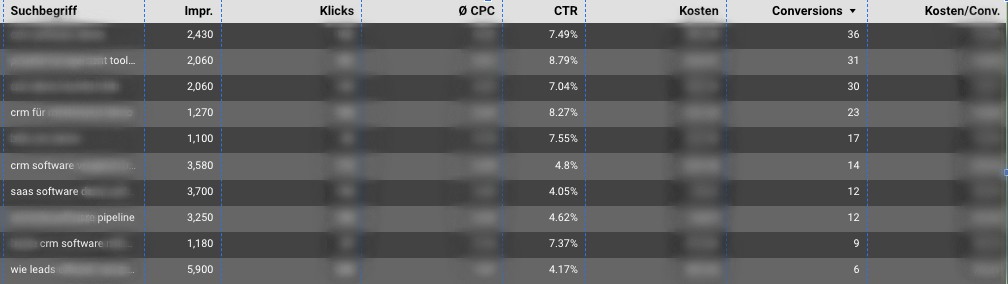
Continuous search term analysis helped identify new keyword opportunities while filtering out low-quality traffic using negative keywords.
Funnel & Campaign Structure
The account combined high-intent search campaigns with demand generation channels to create a full-funnel lead generation system.
Google Ads (Search Campaigns)
Focused on high-intent solution-based queries.
Structured by use case, feature, and audience segment.
Optimized for demo bookings and trial signups.
LinkedIn Ads (Demand Generation)
Targeted decision-makers based on job title, company size, and industry.
Used for awareness and retargeting across longer sales cycles.
Supported multi-touchpoint conversion journeys.
Funnel Structure
Dedicated landing pages with clear value propositions.
Multi-step qualification forms to improve lead quality.
Direct integration with demo booking or trial signup flows.
Budget & Optimization Strategy
Campaign performance was continuously monitored and optimized based on real conversion data.
Key optimizations included:
Reallocating budget toward high-performing campaigns and audiences.
Increasing spend on high-intent keywords and converting segments.
Optimizing funnel steps to reduce drop-offs.
Refining targeting and messaging based on performance insights.
This ensured scalable growth while maintaining efficient cost per lead and improving overall lead quality.
From Click to SQL: Funnel Structure Overview
(7.4% CVR)
(↑ Lead Quality)
Performance Overview
Traffic & Cost Trends
During the initial phase, budgets were allocated conservatively to establish a reliable data foundation and identify high-performing audience segments and keywords.
As optimization progressed, traffic quality improved significantly through refined targeting and keyword segmentation, leading to more efficient acquisition despite competitive SaaS CPCs.
Unlike short-term campaigns, SaaS lead generation requires continuous data accumulation. As more conversion data became available, campaign efficiency increased and cost stability improved over time.
Conversions & Cost Per Lead
Demo requests and trial signups increased steadily as the funnel structure and campaign targeting were optimized.
Despite scaling budgets and increasing traffic volume, the cost per lead decreased due to improved targeting precision and better alignment between ads and landing pages.
Conversion rates improved significantly compared to the initial phase, driven by a clearer funnel structure, reduced friction, and more relevant messaging.
Performance Quality Indicators
Beyond volume metrics, several indicators confirmed sustained improvements in campaign performance:
• Higher conversion rates across funnel steps
• Improved lead qualification and sales readiness
• Stable or decreasing cost per lead during scaling
• Reduced wasted spend through refined targeting and exclusions
• Increased predictability in monthly pipeline generation
These results indicate that performance gains were driven primarily by improved funnel structure, targeting precision, and data-driven optimization rather than budget increases alone.
📊 Results & Impact
To make the performance impact easier to compare, the most important KPIs are shown below.
After 6 months, the new system delivered measurable improvements:
| Metric | Before | After |
|---|---|---|
| Cost per Lead | €52 | €41 (–21%) |
| Conversion Rate | 5.8% | 7.4% (+27%) |
| Qualified Leads | 100 | 138 (+38%) |
| SQLs | 45 | 108 (2.4×) |
Additional impact:
🔍 Key Learnings
1. Funnel structure drives performance
Sending traffic to generic pages limits results.
2. Tracking is the foundation for scaling
Without data, optimization is guesswork.
3. Lead quality matters more than volume
Better qualification leads to higher revenue.
4. Keyword intent is critical
High-intent traffic consistently outperformed broader targeting.
Full-Funnel Google Ads Management
💣 Why Most SaaS Lead Generation Fails
Many SaaS companies face similar issues:
- campaigns optimized for clicks, not revenue
- lack of funnel strategy
- missing or inaccurate tracking
- poor alignment between marketing and sales
🚀 How ELKEON Solves This
ELKEON builds data-driven lead generation systems:
- structured funnels
- precise tracking
- performance-driven campaigns
- continuous optimization
👉 Result: scalable and predictable growth
READY TO GROW?
Let’s get to work.
What Our Clients Say About Working With Us
“We received active support with our online marketing and achieved excellent results. The team kept us well informed and continuously highlighted opportunities for optimization. The cooperation was friendly, transparent, and highly professional — we are happy to recommend this service.”

“Outstanding work in online marketing, whether it’s SEO or SEA. A true specialist team that is always reliable and takes care of any issues promptly. Highly recommended.”